
 March 30, 2026 | Probus
How IoT-Based Smart Grid Integration Improves Outage Management and Fault Detection
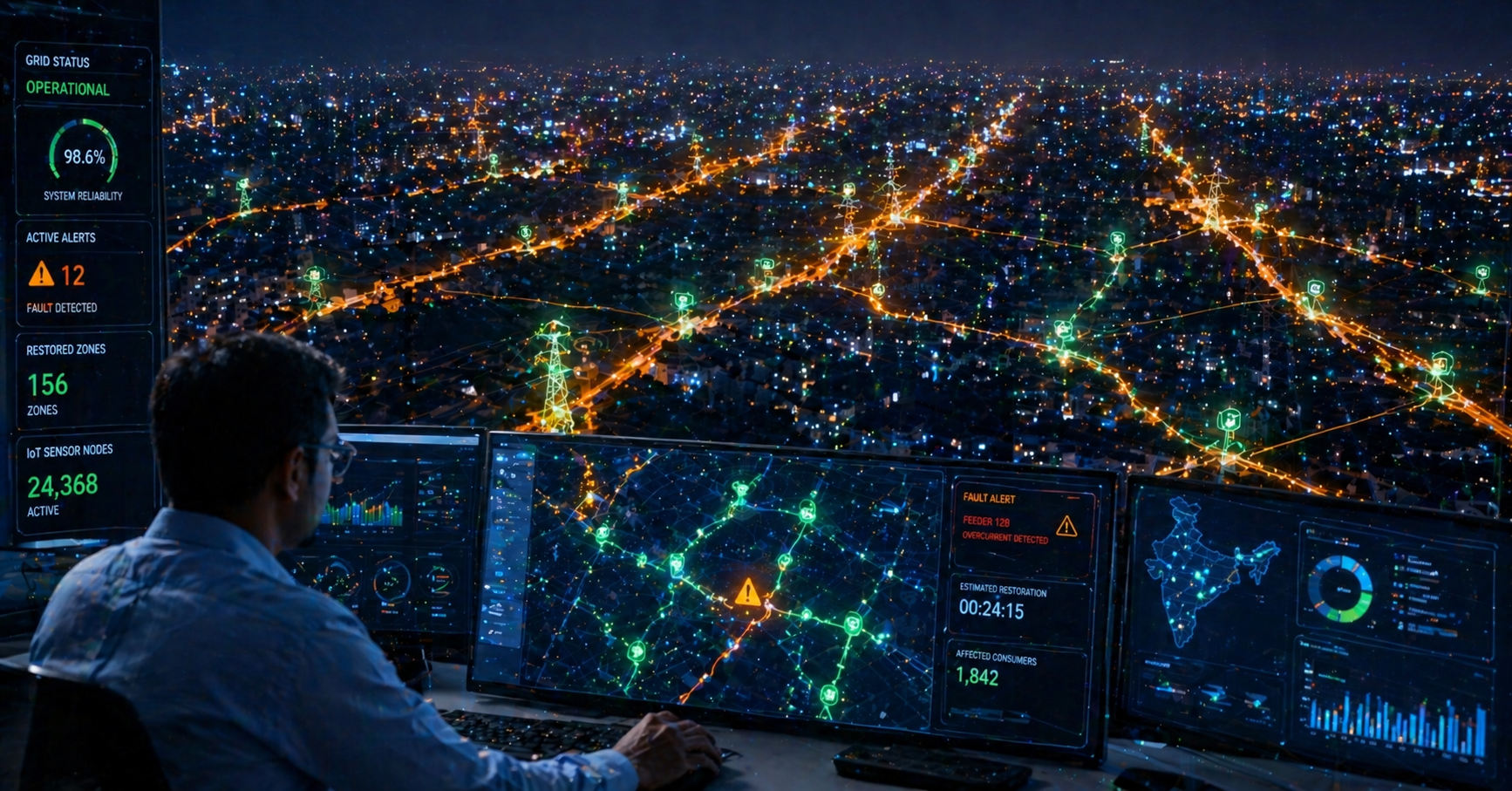
Every unplanned power outage in India tells two stories. The first is the one consumers experience – the inconvenience, the disrupted operations, the economic cost of interrupted supply. The second is the one utilities live through – the frantic phone calls to the control room, the field teams dispatched without precise location information, the manual restoration process that takes far longer than it should, and the post-event uncertainty about what actually caused the fault.
For decades, both of these stories have played out the same way, driven by the same fundamental problem: most of India’s distribution grid has been operating blind. Without real-time visibility into what is happening at the feeder, Distribution Transformer, and consumer level, outages are detected reactively – when consumers complain – and faults are located through manual field inspection rather than data-driven diagnosis.
IoT-based smart grid integration is changing both stories. By embedding connected sensing, monitoring, and communication capabilities throughout the distribution network – from the substation to the last-mile feeder – it gives utilities the real-time grid visibility that transforms outage management from a reactive scramble into a proactive, data-driven operation. This blog explains how that transformation happens, what it means for Indian DISCOMs, and what a well-designed IoT smart grid system looks like in practice.
The Core Problem: Why Traditional Outage Management Falls Short
To understand why IoT-based smart grid integration matters so much for outage management and fault detection, it helps to be clear-eyed about how the process works without it – and why that approach is fundamentally inadequate for a modern distribution network.
In a conventional distribution grid, the utility’s awareness of an outage depends primarily on consumer calls to the helpline. When supply fails at a consumer’s premises, they call to report it. The call centre logs the complaint, a field crew is dispatched to investigate, and restoration proceeds – guided by the crew’s knowledge of the network topology and their physical inspection of the infrastructure.
This process has several compounding problems. First, there is an inherent time delay between when an outage occurs and when enough consumers have called to allow the utility to identify its approximate location. Second, the field crew dispatched to investigate often knows only that there is a fault somewhere in a particular section of the network – not exactly where, or what caused it. Third, restoration verification depends on the field crew confirming supply has been restored, or waiting for consumer callbacks to stop – neither of which is precise or timely.
The result is that Mean Time to Repair (MTTR) – the average time between an outage occurring and supply being restored – is far higher than it needs to be. And every additional minute of outage duration represents real economic cost: to consumers whose operations are disrupted, and to the DISCOM whose AT&C losses increase during unmetered supply interruption periods.
Beyond outages, incipient faults – deteriorating cable insulation, corroded connections, overloaded transformers approaching failure – are invisible in a grid without continuous monitoring. These faults develop gradually, often over weeks or months, before triggering an acute failure. Without the ability to detect them early, the utility can only respond after the failure has occurred – by which point the damage is done and a planned maintenance intervention has become an emergency repair.
What IoT Smart Grid Integration Actually Means
The phrase “IoT smart grid integration” covers a broad technology landscape. For the purposes of outage management and fault detection – the operational functions that most directly affect DISCOM performance and consumer service quality – the relevant components are:
1. Smart Meters as Grid Sensors
The smart meters deployed under RDSS and other metering programmes are not just billing devices. They are distributed sensors embedded throughout the low-voltage network. Every smart meter continuously monitors voltage at the point of supply, logs power outage and restoration events with precise timestamps, detects tamper events, and measures power quality parameters.
When a fault causes supply to fail, meters at the affected premises send a “last gasp” signal – a brief transmission made using the meter’s internal capacitor power reserve in the milliseconds before supply is completely lost. These last gasp signals arrive at the Head-End System almost simultaneously with the fault event itself, giving the control room instant awareness of which meters have lost supply – without waiting for a single consumer call.
By mapping the geographic pattern of meters reporting loss of supply, the MDMS can identify the probable location of the fault with significant precision – narrowing the search from an entire feeder section to a specific DT or cable segment. This transforms the field crew’s task from open-ended investigation to targeted intervention.
This is the foundation of how Probus’s smart metering solutions contribute directly to grid operational intelligence – the meter is not just a data collection device for billing, but a sensing node in a broader IoT grid monitoring network.
2. Distribution Transformer Monitoring
The Distribution Transformer is one of the most critical – and most vulnerable – assets in the low-voltage distribution network. DTs are subject to overloading, oil degradation, winding insulation failure, and the cumulative stress of irregular load patterns. In India, premature DT failure is a significant operational and capital cost for most DISCOMs – both because of the direct cost of transformer replacement and because of the supply interruption that accompanies failure.
IoT-based DT monitoring devices measure load current, voltage, oil temperature, and power factor continuously at the transformer level. By analysing these parameters in real time and trending them over time, the monitoring system can identify DTs that are running hot, overloaded, or showing early signs of insulation degradation – weeks or months before a catastrophic failure occurs.
This enables a shift from reactive DT replacement – waiting for failure – to predictive maintenance – intervening before failure, at a time and in a manner that is planned, cost-effective, and does not result in unplanned supply interruption. For a DISCOM managing thousands of DTs across its network, the cumulative operational and capital cost savings from predictive DT maintenance are substantial.
3. Feeder and Substation Automation
At the feeder and substation level, IoT integration involves the deployment of remote terminal units (RTUs), intelligent electronic devices (IEDs), and automated switching equipment that can be monitored and controlled from a central SCADA or Distribution Management System (DMS). Fault indicators installed along feeder lines detect and log fault current events, allowing the control room to identify not just that a fault has occurred but at which point along the feeder it is located.
In networks equipped with automated sectionalising switches, fault isolation and network reconfiguration can be performed remotely – isolating the faulted section and restoring supply to the unaffected portions of the feeder without requiring a field crew to manually operate switching equipment. This dramatically reduces the number of consumers affected by a fault and the duration of supply interruption for those who are.
4. Power Quality Monitoring
Beyond outage events, the IoT energy meter and grid sensor network continuously monitors power quality parameters – voltage sags and swells, harmonic distortion, frequency deviation, and power factor. These parameters affect both consumer equipment reliability and grid asset health. Chronic voltage sags in a particular feeder section may indicate a network impedance problem. Persistent harmonic distortion may signal the proliferation of non-linear loads that are affecting grid power quality.
Real-time power quality monitoring allows the utility to identify and address these conditions proactively – before they result in consumer complaints, equipment damage, or regulatory non-compliance. It also provides the data needed to plan network reinforcement investments based on actual power quality conditions rather than theoretical load projections.
From Data to Action: How Real-Time Grid Monitoring Works in Practice
The value of IoT smart grid integration is not in the data itself – it is in what the utility does with that data. The operational workflow that translates real-time energy monitoring system data into improved outage management looks like this:
Step 1 – Event Detection: A fault occurs on the network. Smart meters in the affected area send last gasp signals. DT monitoring devices log the loss of secondary voltage. Fault indicators on the feeder register the fault current event. All of these signals arrive at the central monitoring platform within seconds of the fault occurring.
Step 2 – Fault Location: The monitoring platform analyses the pattern of signals – which meters reported supply loss, which DT monitoring device registered a voltage drop, which feeder fault indicator logged a current event – and uses network topology data to calculate the probable location of the fault. An alert is generated in the control room with the fault’s likely location identified to a specific feeder section or DT.
Step 3 – Field Dispatch: Instead of dispatching a crew with a general instruction to “investigate a fault on Feeder X,” the control room dispatches a crew to a specific location – the section of feeder identified by the fault location analysis – with information about the type of fault event that was recorded. The crew arrives prepared for what they are likely to find.
Step 4 – Isolation and Restoration: In networks with automated switching, isolation of the faulted section and restoration to unaffected consumers may be completed remotely before the field crew arrives. In networks without full automation, the precise fault location data still significantly reduces the time the crew spends physically locating the fault before they can begin repair.
Step 5 – Restoration Verification: When supply is restored, smart meters in the previously affected area send power-on notifications. The monitoring platform confirms restoration automatically – the control room can see, in real time, which meters have supply back and which do not, without relying on field crew reports or consumer callbacks.
This five-step data-to-action workflow is what real-time grid monitoring actually delivers in operational terms. It is not a theoretical improvement – it is a measurable reduction in MTTR that DISCOMs implementing IoT-based grid monitoring consistently report once their systems are fully operational.
Distribution Automation India: The AT&C Loss Connection
The connection between IoT smart grid integration and AT&C loss reduction goes beyond outage management. Real-time network visibility enables a range of loss-reduction capabilities that are simply not possible without continuous, granular monitoring data.
Energy Balancing and Loss Localisation
When smart meters are deployed at the consumer level and DT meters are deployed at the transformer level, the monitoring system can continuously compare the energy measured at each DT against the sum of energy measured by all meters connected downstream. Any consistent gap between these two figures indicates a loss – whether technical (cable losses, transformer no-load losses) or commercial (theft, unbilled connections, meter bypass).
The ability to perform this energy balance calculation at the DT level – not just at the substation or feeder level – localises loss to specific sections of the network. Instead of knowing that a DISCOM has 18 percent AT&C losses overall, the utility knows that Transformer X on Feeder Y has a 35 percent loss gap and Transformer Z on the same feeder has a 4 percent loss gap. That precision transforms loss reduction from a general programme into a targeted, prioritised intervention effort.
Tamper Detection and Theft Identification
Smart meters connected to an IoT monitoring platform generate tamper event logs in real time – cover open events, magnetic field interference detections, neutral disturbance alerts, and load profile anomalies that suggest meter bypass. When these events are correlated with energy balance data from the relevant DT, the monitoring system can identify not just that a tamper event occurred, but whether it correlates with an unexplained increase in the DT’s loss gap – providing evidence of commercial loss at a specific meter point.
This evidence-based approach to theft identification is fundamentally more efficient than the traditional inspection-based approach, where field teams conduct periodic random checks across the network with limited ability to prioritise which consumers to inspect.
Smart Grid Reliability: What Good Looks Like for Indian DISCOMs
The operational performance improvements that IoT-based smart grid integration enables can be measured against a set of industry-standard reliability metrics that DISCOMs and regulators use to assess distribution network performance:
- SAIDI (System Average Interruption Duration Index): The average total duration of supply interruptions per consumer per year. IoT-based fault detection and automated switching directly reduce SAIDI by shortening both fault location time and restoration time.
- SAIFI (System Average Interruption Frequency Index): The average number of supply interruptions per consumer per year. Predictive maintenance enabled by continuous DT and feeder monitoring reduces the frequency of unplanned failures – directly improving SAIFI.
- CAIDI (Customer Average Interruption Duration Index): The average duration of each interruption experienced by consumers. Faster fault location and dispatch reduces CAIDI even when interruptions cannot be prevented.
- AT&C Loss Percentage: Real-time energy balancing and tamper detection directly reduce commercial losses, while improved fault management reduces the duration of periods during which unmetered supply creates technical loss accounting gaps.
DISCOMs that have implemented comprehensive IoT-based grid monitoring consistently report improvements across all four of these metrics within the first 12 to 24 months of full system operation. The improvements are not marginal – utilities that move from complaint-driven outage detection to real-time IoT monitoring typically see MTTR reductions of 40 to 60 percent in the first year, with ongoing improvements as the analytics layer matures.
Smart Energy Management: Integrating Renewables and Managing Demand
The benefits of IoT smart grid integration extend beyond outage management and fault detection into the broader challenge of smart energy management for a grid that is increasingly complex. As rooftop solar proliferates, as EV charging loads emerge on distribution feeders, and as demand-side management programmes become operational priorities, real-time grid visibility becomes the enabling foundation for all of these capabilities.
A DISCOM with full IoT monitoring across its network can see, in real time, the impact of rooftop solar generation on feeder voltage profiles – and respond proactively to voltage rise events that can affect power quality and equipment reliability. It can identify which feeders are approaching capacity limits during peak EV charging periods and make data-driven decisions about network reinforcement priorities. And it can implement demand response programmes that target specific consumer groups based on real-time load data – rather than broad, blunt interventions that affect the entire network.
These capabilities are not futuristic. They are available today, through the integration of smart metering data, IoT sensor networks, and advanced analytics platforms. The DISCOMs that build this foundation now will be the ones positioned to manage the energy transition effectively as India’s distribution grid becomes progressively more complex over the next decade.
For utilities looking to understand how smart grid integration technology can be applied to their specific network challenges, the combination of IoT sensor deployment, data architecture, and analytics capability is what determines how quickly that operational transformation becomes real.
Implementation Considerations: Building an IoT-Ready Grid
For DISCOMs planning IoT-based smart grid integration, the implementation pathway involves decisions across several dimensions:
Start With the Data Foundation
IoT smart grid integration is ultimately a data problem. The sensors generate the data, but the value is created by the systems that collect, process, and analyse it. Before deploying field devices, DISCOMs should ensure that their Head-End System, MDMS, and Distribution Management System are architected to receive and process data from IoT devices at scale – and that the analytics layer is designed to generate actionable insights, not just data dashboards.
Deploy in Layers
Full IoT grid integration does not need to happen all at once. A phased approach – starting with consumer smart meters and DT monitoring, then adding feeder fault indicators, then progressing to automated switching – allows the utility to build operational experience with real-time data at each stage before adding the next layer of complexity.
Invest in Control Room Capability
The operational value of real-time grid monitoring depends on the control room’s ability to interpret and act on the data it receives. This requires investment in operator training, upgraded SCADA and DMS software, and well-designed alerting systems that present the most critical information clearly and actionably – rather than overwhelming operators with raw data streams.
Integrate Across Systems
The full value of IoT smart grid data is only realised when it flows across the utility’s operational systems – from the monitoring platform to the outage management system, to the work order management system, to the billing and ERP platforms. System integration is often the most complex and time-consuming aspect of smart grid implementation, and it requires early, detailed planning to avoid the data silos that prevent end-to-end operational benefit.
The depth of experience required to navigate these implementation decisions across diverse utility environments is exactly what Probus brings to smart grid integration projects – from initial network assessment through to system commissioning and operational support. And for utilities wanting to understand how AMR devices and grid sensors work together as a unified sensing layer, the journey from basic metering to full grid intelligence is explored in detail in our blog on how 4G AMR devices become distribution sensors.
Conclusion
India’s distribution sector is at a defining moment. The investments being made today under RDSS – in smart meters, communication infrastructure, and data systems – are laying the foundation for a fundamentally different kind of grid: one that is visible, intelligent, and responsive in real time.
IoT-based smart grid integration is what turns that foundation into operational capability. It is what transforms smart meters from billing devices into grid sensors. It is what makes outage detection instantaneous rather than complaint-driven. It is what enables fault location to be data-directed rather than field-discovered. And it is what makes predictive maintenance – catching the DT that is about to fail before it does – a reality rather than an aspiration.
For DISCOMs, the operational and financial case for IoT-based grid monitoring is clear and well-evidenced. Faster outage restoration. Reduced AT&C losses. Lower field operations costs. Improved regulatory compliance metrics. Better consumer service. These are not theoretical outcomes – they are the documented results of utilities that have made the investment in real-time grid visibility and built the operational capability to act on what they see.
The question for every DISCOM is not whether IoT smart grid integration is worth pursuing. It is how to sequence the investment, design the right architecture, and build the operational capability to get the most out of it. If your organisation is working through any part of that journey, the Probus team is ready to help – with the technology, the integration expertise, and the field experience to turn real-time grid data into real operational results.
 About us


We specialize in delivering innovative energy solutions that drive efficiency and sustainability. With our cutting-edge hardware and software offerings, we empower businesses to optimize their energy consumption, reduce costs, and make a positive environmental impact.


 May 25, 2025