
 March 2, 2026 | Probus
How Wireless Solar String Monitoring Reduces O&M Costs for Large-Scale Plants
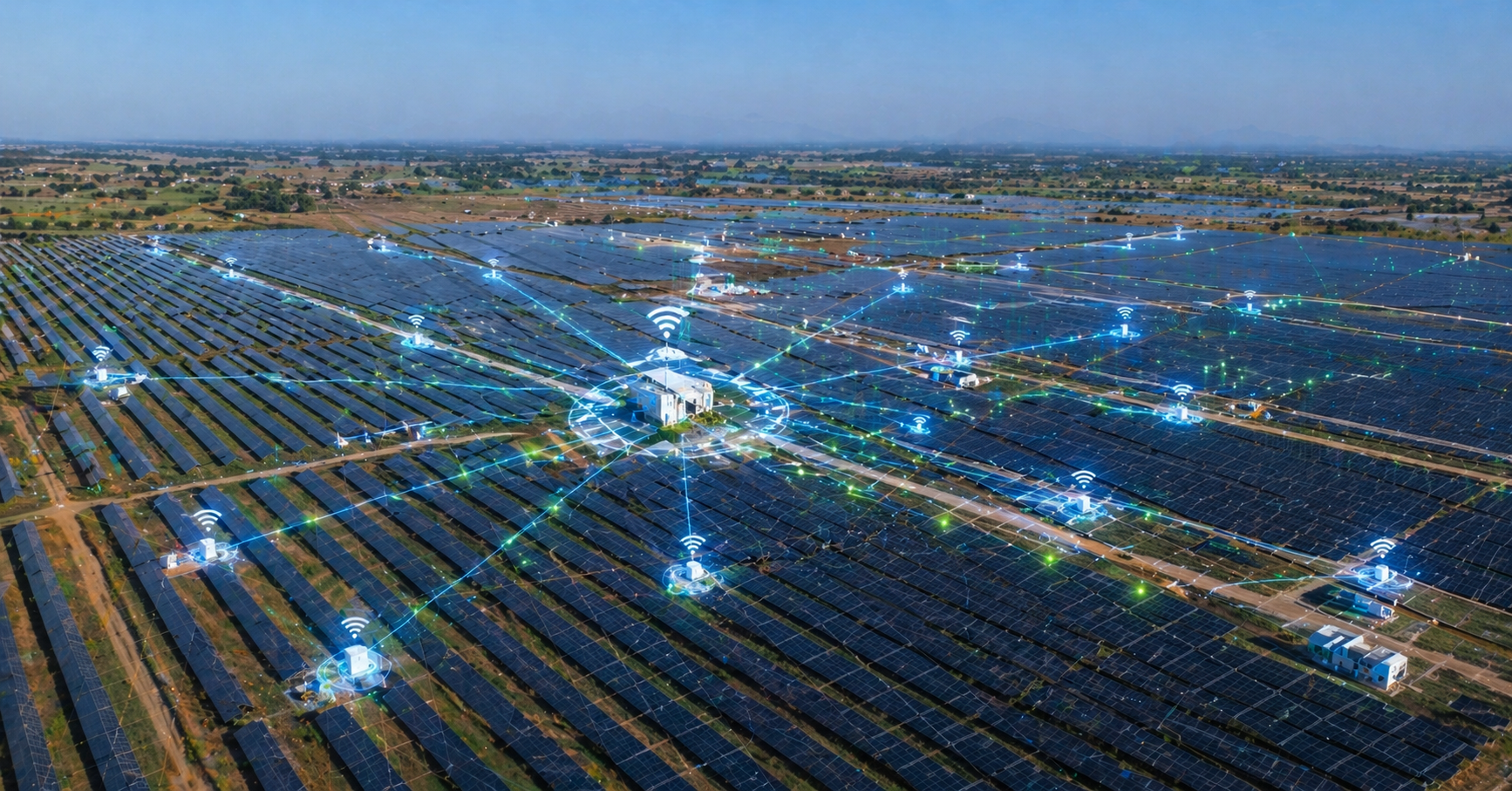
India’s solar energy sector is scaling at a speed that few could have predicted even five years ago. Gigawatt-scale solar parks are becoming commonplace. Rooftop installations are multiplying across industrial and commercial rooftops. And with every megawatt commissioned, the pressure on operations and maintenance teams grows heavier.
Because here is the reality that every solar plant developer, IPP, and EPC contractor eventually confronts: installing a solar plant is one cost. Keeping it performing at its designed output, year after year, is another. And in India’s O&M landscape – where plants are large, geographically dispersed, and subject to aggressive dust, heat, and humidity – the gap between what a plant should generate and what it actually generates is often wider than it should be.
Wireless solar string monitoring is the technology that is closing that gap. Not by changing how solar panels work – but by giving O&M teams the data they need to find problems fast, act on them precisely, and stop revenue from bleeding away undetected. This blog explains how it works, why it matters for large-scale plants specifically, and what the real-world impact on O&M costs looks like.
Why Large-Scale Solar Plants Face a Unique O&M Challenge
A rooftop solar system of 50 kW can be physically inspected end-to-end in an afternoon. A ground-mounted solar power plant of 50 MW cannot. The sheer physical scale of utility-grade installations – spanning dozens or hundreds of hectares, with tens of thousands of individual modules connected across hundreds of strings – makes manual inspection both time-consuming and fundamentally inadequate as a primary fault detection strategy.
Yet this is exactly how the majority of large solar plants in India are maintained today. Periodic site visits. Scheduled cleaning rounds. Reactive maintenance triggered when an inverter alarm becomes impossible to ignore. The result is a systematic delay between when a performance problem develops and when it is detected and resolved – and during that delay, generation loss accumulates quietly and consistently.
The numbers bear this out. Industry data from solar plants across India consistently shows that O&M-preventable losses – faults, soiling, degradation, and mismatch – account for somewhere between 8 and 20 percent of potential annual generation at plants relying on conventional monitoring approaches. For a 10 MW plant generating at a tariff of ₹3 per unit, even the lower end of that range represents significant annual revenue loss.
The challenge is not that plant operators do not want to do better. It is that without granular, continuous data from the field, they simply cannot see the problems that need solving.
What Is Solar String Monitoring – and Why Does the String Level Matter?
In a solar plant, panels are wired together in series to form strings. Multiple strings connect into a combiner box or directly into an inverter. The inverter aggregates the output of all connected strings and converts it to AC power for grid injection.
Conventional plant monitoring typically measures performance at the inverter level – meaning the data you see reflects the combined output of anywhere from 8 to 20 or more strings at once. If one of those strings is underperforming due to soiling, a faulty panel, shading, or degradation, the inverter-level data may not clearly reveal it. The underperforming string is averaged in with the healthy ones, and the aggregate number may still look broadly acceptable.
This is the fundamental limitation of inverter-level monitoring alone. String monitoring places measurement at the string level – each string’s current and voltage are measured individually, continuously, and compared against expected performance benchmarks. When a string deviates from its expected output by more than a defined threshold, an alert is triggered immediately.
The result: problems that would previously go undetected for weeks or months are identified within hours. And the O&M team knows exactly which string is affected, where it is physically located in the array, and what the data pattern suggests about the probable cause – before a technician ever sets foot on site.
Why Wireless Changes Everything for Large-Scale Deployment
String monitoring is not a new concept. Wired string monitoring systems have existed for years. But wired deployment at scale across a large solar power plant carries significant practical challenges: communication cables must be routed from each string combiner box back to a central data logger, conduit must be installed across the site, connections are exposed to heat, moisture, and rodent damage, and any cable fault requires field investigation to locate and repair.
In a plant of 20 MW or larger, the installation cost and long-term maintenance burden of a comprehensive wired monitoring network can be substantial – enough that many developers historically decided the economics did not justify it, particularly for plants that were already commissioned without wired monitoring infrastructure built in.
Wireless solar string monitoring removes all of these constraints. Compact, low-power wireless sensors are attached directly at the string or combiner box level. They communicate via radio frequency protocols to gateway nodes positioned across the plant – nodes that require only a power connection, not a cable run to every string. The gateways connect to the cloud monitoring platform over cellular or site broadband.
The installation of a wireless monitoring system across a large solar plant can be completed in a fraction of the time required for a wired equivalent, with no civil works, no conduit, and no disruption to plant operations. And crucially, it can be retrofitted onto existing plants – even those that have been operating for several years without string-level visibility.
This is the specific capability at the core of Probus’s solar monitoring solutions – patented wireless sensor technology engineered for the operating conditions and scale of India’s solar fleet, from large rooftop installations to utility-scale ground-mounted parks.
The Direct Impact on O&M Costs: Five Mechanisms
The cost savings from wireless solar string monitoring flow through five distinct channels. Understanding each of them helps build the honest business case for the investment.
1. Faster Fault Detection Reduces Cumulative Generation Loss
Every day a string fault goes undetected is a day of generation loss. A string producing at 70 percent of its expected output due to a faulty bypass diode or panel-level hotspot loses 30 percent of its contribution to the array for every hour it operates. With conventional monitoring, that fault might not be identified for two to four weeks – or until the next scheduled site visit. With wireless string monitoring, the alert is generated within the first monitoring cycle after the fault develops.
Compounding this across a large plant with multiple simultaneous low-level faults – which is the norm, not the exception, in mature solar installations – the difference in annual generation between monitored and unmonitored plants becomes very significant.
2. Data-Driven Cleaning Schedules Cut Labour and Water Costs
Cleaning is one of the largest recurring O&M costs for solar plants in India, particularly in dust-intensive regions. Most plants clean on a fixed schedule – every 7, 10, or 14 days – regardless of actual soiling levels. This means some strings are cleaned when they do not need it, while others accumulate soiling faster than the schedule anticipates.
Wireless string monitoring enables performance-based cleaning: O&M teams prioritise cleaning the strings showing the highest performance deviation due to soiling first, and defer cleaning strings still performing within tolerance. This optimisation typically reduces the total number of cleaning cycles required annually while improving the timing and targeting of those that are performed – cutting both water consumption and labour cost simultaneously.
3. Reduced Unplanned Site Visits Through Remote Diagnosis
In conventional O&M, many site visits are triggered by vague performance concerns – the plant seems to be underperforming based on aggregate data, so a team is dispatched to investigate. These investigation visits are expensive, time-consuming, and often inconclusive because the root cause is not clear until the team is on site.
With wireless string monitoring, the data tells the story before anyone leaves the office. An alert specifying which string is affected, what the deviation looks like, and how long it has been occurring allows O&M planners to determine remotely whether the issue requires an urgent dispatch or can be bundled into the next scheduled visit. Unplanned investigative visits are dramatically reduced, and when technicians are dispatched, they arrive prepared – with the right tools for the diagnosed fault.
4. Early Detection Prevents Expensive Equipment Damage
Some solar panel faults – particularly hotspots caused by partially shaded or degraded cells, and potential-induced degradation – worsen progressively if not addressed. A panel with a developing hotspot that is identified and replaced early costs far less than one that has been running hot for six months and has caused damage to adjacent cells or the module backsheet.
Wireless string monitoring’s ability to flag performance anomalies at the earliest stage means that maintenance interventions happen when they are still relatively minor and low-cost – rather than after a fault has had time to escalate into a more significant and expensive equipment issue.
5. Performance Benchmarking Strengthens Warranty and EPC Accountability
For plant owners managing PPA obligations and equipment warranties, string-level performance data is a powerful tool for accountability. If a specific string consistently underperforms relative to its neighbours despite cleaning and maintenance, the data provides evidence to support a warranty claim with the panel manufacturer. If a plant commissioned by an EPC contractor fails to meet its designed performance guarantee, string-level data allows the specific sources of underperformance to be isolated and attributed.
This accountability layer – which conventional monitoring simply cannot provide – has real financial value that is often overlooked in the O&M cost reduction conversation.
Installation of Photovoltaic Panels and the Right Time to Add Monitoring
The ideal moment to implement wireless string monitoring is at the time of commissioning – integrating the sensor hardware into the plant design from day one and establishing baseline performance benchmarks against which future data can be compared.
But the practical reality is that a large proportion of India’s existing solar fleet was commissioned without string-level monitoring. For these plants, the question is not whether to add monitoring – it is when and how. The answer, in almost every case, is: sooner rather than later.
The older a plant gets, the more likely it is to have developed performance issues that have been silently accumulating. Retrofitting wireless monitoring onto a plant that has been operating for three to five years typically surfaces a range of previously unknown faults and inefficiencies – the identification and resolution of which often pays for the monitoring system within the first year of operation.
For new plants under design, the conversation about solar O&M strategy and monitoring architecture should happen at the pre-installation stage – not after commissioning is complete. The choices made at that stage determine how visible the plant’s performance will be throughout its 25-year operating life.
What Good Wireless String Monitoring Looks Like in Practice
Not all wireless monitoring systems are created equal. For plant owners evaluating options, here are the capability markers that separate a genuinely useful system from one that generates data without delivering actionable intelligence:
- String-level granularity: The system must measure at the individual string level – not at the combiner box level aggregating multiple strings – to provide the fault isolation precision that makes monitoring operationally useful.
- Irradiance-corrected benchmarking: Performance deviations must be assessed against irradiance-adjusted expected output, not absolute values. A string generating less on a cloudy day is not underperforming – the analytics must account for this.
- Automated alerting with fault classification: The platform should classify alerts by probable cause – soiling, shading, panel fault, string disconnect – to guide the O&M response without requiring manual data interpretation.
- Historical trend analysis: The system should track string performance trends over time, enabling the identification of gradual degradation trajectories before they reach acute fault thresholds.
- Portfolio dashboard: For operators managing multiple plants, a unified view across the portfolio – showing relative performance, active alerts, and O&M status – is essential for efficient resource allocation.
Connecting Solar Monitoring to the Broader Energy Intelligence Picture
Wireless solar string monitoring does not exist in isolation. For DISCOMs and utilities managing both generation assets and distribution infrastructure, the data from solar monitoring systems feeds into the same operational intelligence picture as grid monitoring, feeder data, and demand analytics. The convergence of these data streams – solar generation performance, grid load, and consumer demand – is where the real value of smart grid integration begins to be realised.
A DISCOM that can see, in real time, that a rooftop solar installation on a commercial feeder is underperforming – and correlate that with feeder load data – has a fundamentally better picture of its distribution network than one relying on periodic manual reports. This integration of generation and grid data is the direction that energy infrastructure management in India is heading, and solar string monitoring is one of the key data sources feeding into it.
Conclusion
The solar industry in India has solved the installation problem. The challenge now is performance – ensuring that the capacity already in the ground generates the energy it was designed to produce, year after year, at the lowest possible O&M cost.
Wireless solar string monitoring is the most direct and effective tool available to address that challenge for large-scale plants. It closes the visibility gap that conventional monitoring leaves open. It enables O&M teams to work from data rather than schedules and guesswork. And it delivers measurable cost reductions – through faster fault resolution, optimised cleaning, reduced site visits, and better equipment care – that compound over the lifetime of the plant.
For developers, IPPs, and O&M contractors managing large solar assets in India, the question is no longer whether wireless string monitoring is worth deploying. The question is how quickly it can be in place – because every month without it is a month of preventable loss.
To learn more about how Probus’s wireless solar string monitoring technology works for large-scale plants, or to discuss a retrofit deployment for an existing installation, reach out to our team – we are working with solar operators across India to make string-level visibility a standard part of every plant’s O&M strategy.
 About us


We specialize in delivering innovative energy solutions that drive efficiency and sustainability. With our cutting-edge hardware and software offerings, we empower businesses to optimize their energy consumption, reduce costs, and make a positive environmental impact.


 May 25, 2025